“We call it guts.”
American scout Tony Roig mentioned the Japanese word hara. One sentence grew into a search for Japanese hitters, pitchers and their martial-arts teachers.
By the numbers
- 175sources and links
- 31photographs
- 124people in the index
- 69glossary terms
- 3language versions
When I came across a remark in Dollar Sign on the Muscle (1984) by the American ballplayer and later scout Tony Roig (1928–2010) about Japanese coaches and their word hara (腹), my attention stopped at that single word. It was not the discovery of an unknown Japanese concept. I knew hara (腹) from years spent studying Asian martial arts. I also knew how hard it is to translate: at one moment it means the belly and the center of gravity, at another courage, concentration, firmness of character, or a state in which movement and decision no longer pull apart. That is exactly why it surprised me to find the word in an American book about baseball scouting.
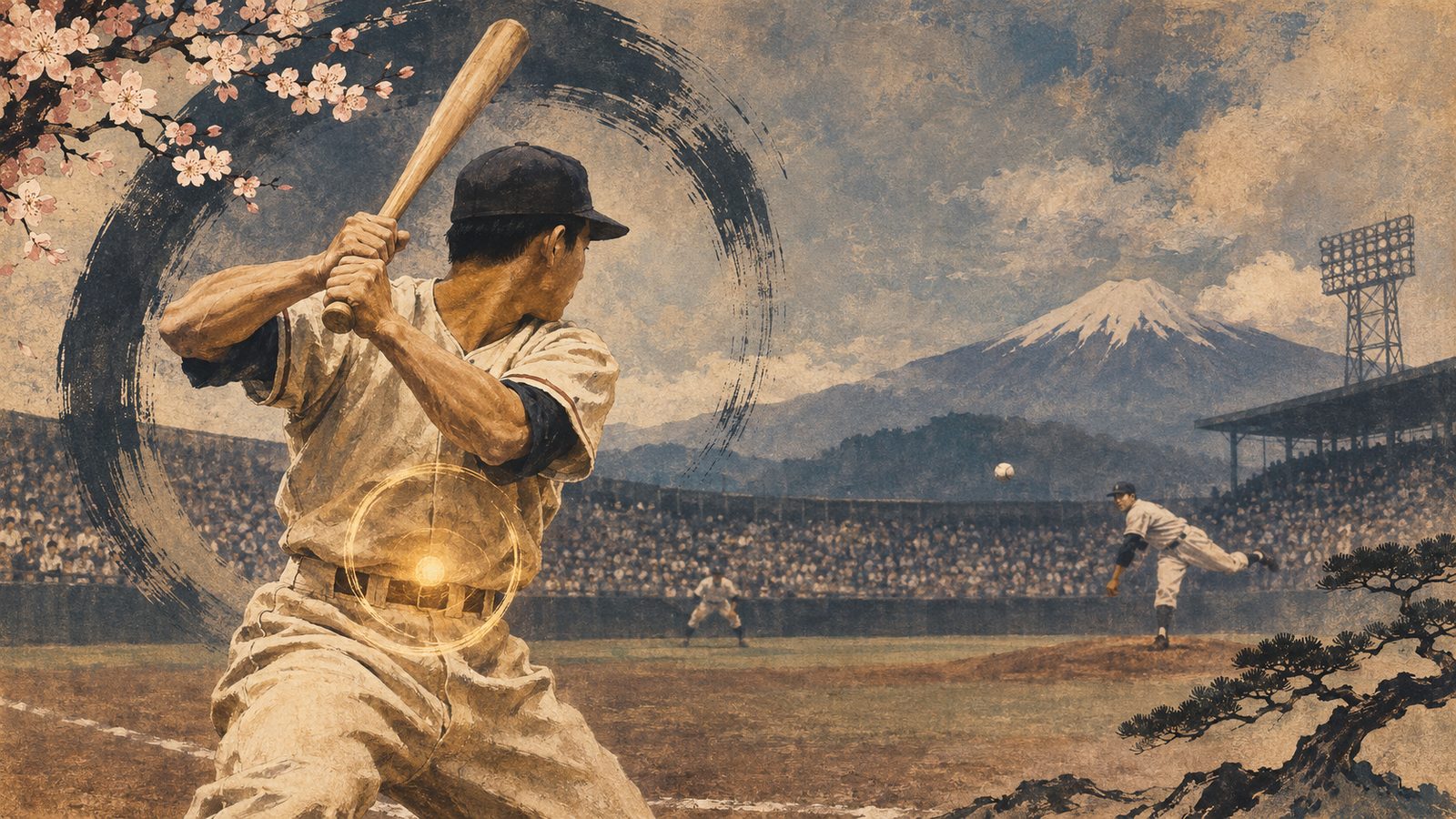
In the martial arts one meets similar ideas again and again, if under different names. Starting from a simple stance and the repetition of basic techniques, the student is meant to arrive gradually at movement in which neither a straining for power nor inner hesitation can be seen. A teacher may speak of hara (腹), tanden (丹田), mushin (無心), fudōshin (不動心) or ki (気/氣). In all these traditions it is a long, sometimes lifelong journey toward one’s own physical and mental center. My experience with the martial arts led me to the question that became the basis of this study: could a similar ideal be fulfilled in baseball too, especially in hitting, where success is decided in a fraction of a second?
Roig’s remark was the first impulse for my search. What actually led me to write this study, however, was something else: the reactions I kept meeting among people in Czech baseball. Some of them have devoted many years to the game, yet any mention of martial arts in connection with hitting or pitching drew raised eyebrows, an amused smirk or automatic dismissal. This surprised me all the more because I did not have in mind some loose resemblance between a swing and a sword cut, but concrete historical links between players, coaches and teachers, documented in contemporary interviews, memoirs and scholarly work. I gradually concluded that this part of baseball history remains almost unknown in my country. With this article I would like to fill at least part of that gap and offer interested readers the names, sources and stories that let them look at baseball from a less usual perspective.